What is permanent residency? Explaining the conditions for obtaining a permanent residence visa in Japan and the difference between naturalization and other matters
Updated: July 2026, 8
For foreigners who wish to stay in Japan for a long time, the key to stability and new possibilities for the future is ``permanent residence visa".
A permanent resident visa is different from a general tourist visa or student visa.Once obtained, you will have unlimited residency rights.
In this article, we will touch on the differences between permanent residence and naturalization, and introduce the key points for a smooth application for a permanent residence visa, including the timing and benefits of obtaining a permanent residence visa, application requirements, and necessary documents. We will also introduce the relationship with existing residence statuses and use actual examples to introduce the key points for a smooth application for a permanent residence visa.

*This page is intended for foreigners residing in Japan.
Check it out in the video! (Japanese/Chinese)

What is permanent residency?
Permanent residency is the right of a foreigner to live permanently in the host country without any restrictions on the period of stay.
A permanent resident visa in Japan is a residence status that allows you to live in Japan for the rest of your life.
Once you obtain permanent residency, you will no longer need to apply for a visa unless there are special circumstances.
However, the validity period is seven years, so when the period expires, you will need to renew it at the Immigration Bureau.
When should I apply?
You can apply at any time.
However, if your current status of residence expires while you are applying, you will need to separately apply for permission to extend your period of stay.
You can apply for permanent residence and extension of your period of stay at the same time, so if you have the documents for your permanent residence application before your period of stay expires, it is better to apply at the same time.
Additionally, if you are granted permanent residence while applying for permission to extend your period of stay, there is no need to separately cancel your application for permission to extend your period of stay.

The benefits of obtaining permanent residency and becoming a permanent resident
①Restrictions on period of stay will be removed.
Once you obtain permanent residence, you will no longer need to renew your residence status.
Each status of residence has a period of stay, and you must apply for renewal before the period of stay expires.
For foreigners who want to stay in Japan for a long time, the renewal process alone takes a lot of time and effort.
However, once you obtain permanent residence, you do not need to renew your residence status.
Unless you are deported, you can continue to stay in Japan.
(However, it is necessary to exchange for a new residence card once every 7 years)
②Restrictions on residence activities will be removed.
If you have permanent residency, you are basically free to choose your occupation.
Technology · Humanities · International workWe often hear from people who have the following residence status:
"I want to change jobs to advance my career, but I can't because of the jobs I can do with my current visa."
"I'm interested in running a company in Japan, but getting a business/management status of residence is too difficult..."
That's it.
Once you obtain permanent residency, there will be no restrictions on working, and you will be able to work freely.
In addition, there are no restrictions on capital or office space for company management, which lowers the hurdles.
③Family members will have an advantage in applying for permanent residence permits, etc.
Once you obtain permanent residence, you will no longer need to renew your residence status.
Unless you are deported, you can continue to stay in Japan.
Additionally, if you divorce or die from your Japanese spouse, even if you have to return to your home country under a spouse visa, you can continue living in Japan if you obtain permanent residency.
④ Work restrictions for family members will be eased.
If you have the "Engineer/Specialist in Humanities/International Services" status of residence and wish to bring your spouse or children to Japan, you will need to obtain the "Dependent" status of residence.
Under "Dependent Stay," you must receive permission to engage in activities other than that permitted under the status of residence previously granted, work hours are limited to 28 hours a week, and you can only work part-time.
Once you obtain permanent residency, your spouse will be able to change his or her residence status to "spouse of a permanent resident," and there will be no restrictions on working, which will greatly expand your options for work in Japan.
⑤Easier to gain social trust
Since people are recognized as having a foundation for living in Japan for a long time, it becomes easier to gain social trust, including in business transactions.
In particular, one of the worries of foreigners living in Japan is "purchasing a home."
When purchasing a home, you often take out a mortgage loan, but for banks, those who have not obtained permanent resident status have a set period of residence status, and there is a risk that they will have to return to their home country.
Because mortgages require long-term repayments, banks find it difficult to lend to foreigners.
However, by obtaining permanent resident status, you will be treated the same as Japanese people, which will make it easier for you to get a mortgage.

Permanent Resident Visa Application Requirements
To apply for a permanent resident visa, you must meet the following four requirements:
① Must have lived in Japan continuously for more than 10 years
10 years or more is the number of continuous years, and if interrupted, the calculation will start from the beginning.
(*In some cases, permanent residence is granted for less than 10 years, so please contact us separately.)
Of course, you must have a valid status of residence.
If the 10-year period includes a period of study or study abroad, you must reside in the residence with a working status for at least 5 years.
②The period of your current status of residence is the longest.
To apply for a permanent residence visa, you will need to have the longest visa in your residence status, such as a work visa.
In principle, it is difficult to apply for a student visa.
Currently, for visas whose maximum period is 5 years, measures are being taken to make 3-year visas also be considered the maximum period.
The required period of stay may change in the future. Please check the latest information.
③There are no problems with behavior.
Applicants must have a good attitude toward living in Japan, including no traffic violations or criminal records.
However, even if there is a violation, if you have been in good standing for a certain period of time, you may be granted permission.
④ By the applicant's own assets, spouse or other relatives' assets, etc.
being able to earn a living
It is necessary to be able to live a stable life using your own assets and income without becoming a burden on the public.
If you experience a temporary decrease in income due to a job change or other reasons before applying, it may be determined that you are unable to lead a stable life.
Required documents for permanent residence visa application
The required application documents are as follows.
Depending on the situation, you may be asked to submit other documents.
1 | Permanent residence permit application |
2 | Reason for application |
3 | passport(Passport) |
4 | Residence card |
5 | Documents proving your status (Family register, marriage certificate, birth certificate, etc.) |
6 | Copy of resident record (for all members of the household, with no omissions other than My Number) |
7 | Documents proving the occupation of the applicant or the applicant's dependents (certificate of employment, etc.) |
8 | Resident tax taxation certificate/tax payment certificate (past5year) *For spouses of Japanese or permanent residents, past3Years |
9 | Materials proving the assets of the applicant or the person supporting the applicant (Bank balance certificate, real estate registry certified copy, etc.) |
10 | Documents proving the payment status of public pension and public medical insurance premiums (Print screen of “Monthly Pension Record” on Nenkin Net, health insurance card (copy), etc.) |
11 | Reference materials · Guarantee card ・Certificate of enrollment ・Withholding tax slip or tax payment certificate ・Copy of resident record (for all members of the household, with no omissions other than My Number) |
12 | Understanding |
★From October 2021, it is necessary to submit a letter of understanding when applying for a permanent residence permit.
Important points to remember when applying for a permanent residence visa
Thorough preparation and appropriate information are the keys to success in obtaining permanent residence in Japan.
When applying for a permanent residence visa, meeting the residency, conduct, and livelihood requirements are very important. moreover,In some cases, it may be easier to obtain a permanent resident visa if certain conditions are met.
From here on, we will explain in detail the important points for applying for a permanent residence visa in accordance with the above conditions. We will also delve into cases where the conditions are relaxed, and introduce information that anyone aiming to obtain permanent residence should know.

Residency requirements
One of the important points when applying for permanent residence is residency requirements.
Even if you meet the 10-year residence requirement for a permanent resident visa, it will be difficult to apply if any of the following apply to you.
Continuity of residence
You may be disadvantaged if you are away from Japan for more than 3 consecutive months or approximately 1 days in a year.
Also, if you have been away from Japan for a long period of time, such as on a company business trip, which lasts for many years, it may be disadvantageous.
If you change from studying abroad to working
You cannot apply for a permanent residence visa even if you have lived as an international student for more than 10 years.
If you change from a student visa to a work visa and have not stayed in the country for 5 years or more, you will not have met the residency requirements.
About conduct requirements
One of the requirements for a permanent resident visa is "good behavior."
Specifically, if the following does not apply, it can be said that the behavior is good.
In addition, receiving awards or letters of appreciation, volunteer activities, etc. may encourage good behavior.
illegal
Applying for a permanent residence visa requires not only serious crimes.Traffic violations etc. will also affect the examination.
There is no major problem if the traffic violation is a few fines, but if the traffic violation is repeated frequently in a short period of time, or if it is a major traffic violation that will result in a summary prosecution and a ``fine''. It is better to wait a few years and apply for a permanent residence visa.
if,If you have committed a traffic violation, we recommend that you obtain a driving record certificate for the past five years.
Since you will be writing your traffic violation history on your resume, you can avoid making mistakes.
tax evasion
You are required to fulfill your tax obligations properly.
The problem is thatPayment of resident taxwithTax return for business owners.
If there is a period in which you have not been able to properly pay your taxes, you will need to pay your taxes properly before applying.
Delinquency or non-payment of pension/insurance payments
If you are in arrears or have not paid your public pension premiums for the past two years, you may be at a disadvantage.
Previously, there were cases in which a permanent residence permit was issued even if the pension was paid in full at the stage when it was discovered that the pension was in arrears or unpaid.Recently, the screening process for applying for permanent residence has become stricter, and it is now required to make regular payments every month (or pay in full in advance) with no missed payments or delinquent payments for the past two years.
Where can I get my pension documents?
When applying for permanent residence, you will need to submit documents proving that you have paid pension insurance premiums for the past two years or more.
The following article introduces how to print "monthly pension records".
If you don't know how to prepare, please refer to it!
Regarding living conditions
One of the key points when applying for permanent residence is being able to earn a living independently.
It is necessary to explain that the person has an economic base in Japan and is unlikely to receive support such as welfare from the government in the future.
livelihood stability
Those who maintain their livelihood are required to have a stable income for a certain period of time.
Even if it is only temporarily due to a job change, if your income decreases significantly, it may be determined that your livelihood is not stable.
Cases where conditions are relaxed
Some of the conditions for permanent residence have been relaxed for foreign nationals who fall under the following categories.
①For spouses of Japanese nationals, permanent residents, and special permanent residents
You can apply if you have been in a valid marriage for three years or more and have continued to reside in Japan for one year or more.
②In the case of children of spouses of Japanese nationals, permanent residents, and special permanent residents
You can apply if you have continuously resided in Japan for more than one year.
③If the residence status is “Long Term Resident”
You can apply if you have lived in Japan for 5 years or more.
④For those who have been recognized as refugees
You can apply if you have continued to reside in Japan for 5 years or more after certification.
⑤Persons who are recognized to have contributed to Japan in the fields of diplomacy, society, economy, culture, etc.
You can apply if you have lived in Japan for 5 years or more.
⑥ Those recognized as highly skilled human resources
If you have been working as a highly skilled professional for approximately three years, you can apply for a permanent residence visa.
However, if you have 80 points or more, you can apply in one year at the earliest.
Points to note when switching from another status of residence to a permanent resident visa
Switching from a different residence status to a permanent resident visa is an important option when planning a long-term stay in Japan.
However, when switching, there are various points that must be cleared.
This article focuses on "Key points when switching from other residence statuses to a permanent residence visa" and explores the important things that holders of different residence statuses should consider when considering switching to a permanent residence visa.
We will explain the specific procedures and points to note for cases of ➀ Permanent residence visa for spouse, ② Technical/Specialist in Humanities/International Services/Skills, and ③ Highly Skilled Professional Category 1 cases.

Permanent resident visa for spouse of Japanese national/permanent resident
When applying for a permanent residence visa with the residence status of "Spouse, etc. of Japanese National" or "Spouse, etc. of Permanent Resident," please apply for a permanent residence visa from the employment-related residence status ("Engineer/Specialist in Humanities/International Services" or "Skilled Worker"). In addition to the application requirements introduced in , please note the following points.Have you been married for more than 3 years and continue to reside in Japan for more than 1 year?
"Spouse, etc. of a Japanese national" "If you are a spouse of a permanent resident and have continued to reside in Japan for one year or more, you will meet the application requirements." This is a condition for application.
If you have been married for three years or more, and have lived in Japan for one year or more, you will meet the application requirements.
For example, if the applicant married a Japanese person in their home country and lived there for two years, and then lived in Japan for more than one year, they would meet the application requirements.
In addition, if you are married to a Japanese person and are staying in Japan under another status of residence such as "Engineer/Specialist in Humanities/International Services," if more than three years have passed since your marriage, you must continue to stay in Japan for more than one year. If so, you meet the application requirements.
Please note that even if you meet the above application requirements, if you are living separately or living separately, it will not be considered a "substantive marriage" and will not meet the application requirements.
Change from Technical/Humanitarian/International Business/Skilled to Permanent Residence Visa
When applying for a permanent residence visa with a work-related residence status (Engineer/Specialist in Humanities/International Services/Skilled), please note the following points.
①Number of dependents
The number of dependents is an important point to check when applying for permanent residence.
You can check the number of dependents each year on the tax certificate submitted when applying for permanent residence.
If the applicant supports a family, the annual income required to apply for permanent residence will increase accordingly.
Generally, it is thought that an additional annual income of approximately 1 to 70 yen is required for each dependent.
Even if you are applying alone and not as a family member, the required annual income will increase depending on the number of dependents.
Also, if you are supporting your parents in your home country, you may be sending money overseas, but please be aware that you may be required to document the remittance records.
② Number of job changes
If you change jobs many times after coming to Japan, it may work against you when applying for permanent residence.
This is especially important if you are working for many companies in a short period of time.
Additionally, it is best to avoid changing jobs immediately before or during the application process, as this may work against the applicant due to the stability of his or her livelihood in Japan.
③ Pension and social insurance enrollment
If you live in Japan with a work-related status of residence, your pension and social insurance premiums are basically deducted by your company, so I think that payments are basically made. However, the following cases are likely to affect your application for permanent residence.
- I changed jobs a lot, and there were blank periods between job changes, during which I was unable to complete the necessary procedures and was unable to pay my pension and social insurance.
- I joined the company under employment conditions that did not include pension or social insurance, and I was unaware of this fact.
As mentioned above, if you have been in arrears or unpaid public pension premiums for the past two years, one method is to wait until you have no record of this before applying.
④ Employment status of dependents
If the applicant's spouse is residing in Japan as a "dependent" and working part-time, please check the following two points.
- Have you obtained permission to engage in activities other than that permitted under the status of residence previously granted and are you able to work within 28 hours a week?
- Do you have an annual income of 130 million yen or more?
If either of the above applies to you, we recommend that you respond immediately and wait until the appropriate time to apply.
Highly Skilled Professional No. 1 Permanent Residence Visa
Application requirements
Due to the revision of the Ministry of Justice Ordinance on April 2017, 4, those who are recognized as highly skilled professionals with a score of 26 points or more are required to work as highly skilled professionals for more than 70 years, and those who are recognized with 3 points or more are required to work as highly skilled professionals for more than 80 year. If you continue to do so, you can apply for a permanent residence visa.There are broadly two types of applications for permanent residence from highly skilled professionals.
| ① If you already have a highly skilled professional residence status, apply for permanent residence after fulfilling the required number of years. |
Those with a score of 70 or above must have been engaged in activities as high-level human resources for three years, and those with a score of 3 or above must have continued to work for one year or more to meet the application requirements. |
| ② Application for permanent residence if you currently have another status of residence but retroactively meet the points for highly skilled professional |
| For example, if you are currently employed and have a residence status of ``Engineer/Specialist in Humanities/International Services'' or ``Business Manager/Administration'', we calculated the current and past points and found that you have already achieved 70 points or more for 3 years, or If it is found that you have maintained a score of 80 or higher for more than one year, you can retroactively calculate the points as a highly skilled professional and apply for permanent residence, even if you do not have a highly skilled professional residence status. Masu. |
Example of highly skilled professional points
For example, the following is a common example of highly skilled professional points for people with "engineering/humanities/international services".| [Example: If you are 29 years old and in your fourth year of work] |
+20 points Educational background: Japanese graduate school +10 points Annual income: Under 30 years old Annual income: 400 million yen +15 points Age: Under 30 years old +10 points Completed graduate school in Japan +15 points N1 pass +10 points Graduated from a graduate school that is ranked in university rankings
Total 80 points(Currently, points from 1 year ago) |
In this way, if you have graduated from a Japanese graduate school and have high Japanese language proficiency, you can earn a lot of points based on your academic background and Japanese language proficiency, increasing your chances of applying for permanent residence based on the point requirements for highly skilled professionals.
The important points when applying for permanent residence using highly skilled professional points are:Salary estimate certificateis. For highly skilled professionals, "annual income" is included as a point target, but this annual income is currently not eligible for points. It is important to note that this is not the annual income you are currently receiving, but the amount of annual income you are expected to receive in the next year.
So, how do you prove the amount of annual income you are expected to receive in the next year? In this case, a ``salary estimate certificate'' is required.
By having the company issue a salary estimate certificate and clarifying the amount of salary that will be paid over the next year, the Immigration Bureau will also examine the annual salary amount for highly skilled professional points.
If you do not have a salary estimate certificate, you will not be able to apply, so we recommend that you check with the company in advance to see if the documents can be obtained.
Also, the period of "one year from now" is "one year from the month following the month of application."
For example, if you are applying for permanent residence in July 2021, you will need a certificate of estimated salary from August 7 to July 2021.
Points to keep in mind when obtaining permanent residence from a highly skilled professional
| ① The examination period is longer than a normal permanent residence application. |
During the examination, the Immigration Bureau carefully checks the documents submitted as proof of the points of the highly skilled professional, so the examination period tends to be longer than when applying for permanent residence with normal application requirements. |
| ②You need to calculate the points carefully before applying. |
| Only the documents that are explained as points when applying for permanent residence will be examined, so please be careful to ensure that there are no omissions in the documents before applying. For example, even if you have obtained N1, if you do not have any explanatory materials in your application documents or explanations that will be added to N1 points, or explanatory materials (copy of passing certificate), points will not be added. |
The difference between "permanent residence" and "naturalization"
<About procedures>
Permanent resident visa holders are required to complete alien registration and re-entry procedures.
If you naturalize, you will acquire Japanese nationality, so you will not need to undergo any procedures related to foreigners.
<About suffrage>
As permanent resident visa holders are foreign nationals, they are not granted the right to vote.
If you naturalize, you will be granted the right to vote as a Japanese citizen, and you will be able to vote in elections.
<About returning to your home country>
Persons with permanent resident visas do not have any particular problems returning to their home countries.
In the case of naturalization, you will need to go through immigration procedures as a Japanese citizen when returning to your home country.
<About leaving Japan>
Permanent resident visa holders may be deported to their home country if they fall under grounds for deportation due to legal violations, etc.
If you naturalize, penalties will be applied based on Japanese law.
| permanent | Naturalization | |
| Citizenship | Keep your current nationality | Japanese nationality |
| Residence card | 必要 | Must not |
| Renewal of status of residence | Must not | Must not |
| Renewal of residence card | 必要 | None |
| Re-entry procedures | 必要 | Must not |
| Occupation | No limit | No limit |
| Residency activities | No limit | No limit |
| Housing loan | Easy to assemble | Easy to assemble |
| suffrage | None | There |
| japanese passport | None | There |
| Forced deportation due to violation of law | There | None |
Wouldn't you like to leave your visa acquisition to an expert and have it go smoothly?
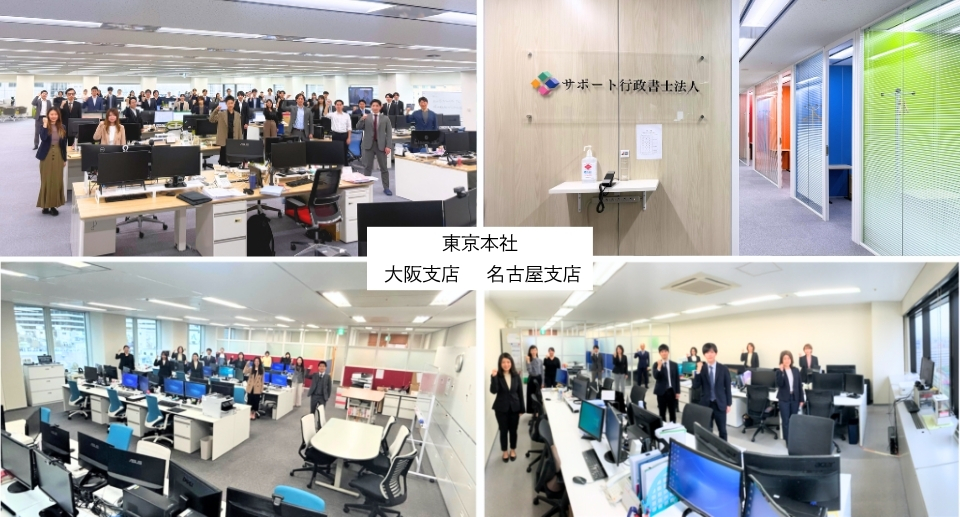
We have offices in Tokyo, Nagoya, and Osaka.
Our experienced and highly qualified visa application specialists will address each client's individual needs.
Even if it is difficult for you to obtain, renew, or change a permanent residence visa on your own, we will work with you to find a solution and provide support.
If you apply for a permanent resident visa yourself at the Immigration Bureau and your application is rejected, please leave it to us to reapply.
We also have staff who can speak foreign languages, so even those who find it difficult to consult in Japanese can feel at ease.
By making preparations tailored to each individual's circumstances, we can avoid problems later on and provide advice on creating an environment that will make it easier for you to stay in Japan.
Benefits of requesting
① Support for preparing documents to be submitted/Application on your behalf
The statement of reasons submitted when applying for a permanent residence visa is an important document that will affect the approval.
We create a customized explanation document for each customer.
② We will review all materials and make necessary proposals
There are some documents that can be disadvantageous if submitted.
We will review all documents to be submitted to the authorities and make the best decision in light of the conditions of the permit.
3. Rest assured that you will be supported by a visa specialist consultant
Our experienced team has gained experience in many cases where obtaining residence status or permission was difficult.
④ Multilingual support available
In addition to Japanese, we can also provide support in Chinese, English, Korean, and Vietnamese.
⑤ Nationwide coverage
Our company has offices in Tokyo, Nagoya, and Osaka, and can handle applications throughout Japan.
⑥ Quick and reliable response
With speedy response as our motto, we will handle your various applications promptly and reliably.
Frequently asked questions
Where do I apply for a permanent residence visa?
Apply at the Immigration Bureau that has jurisdiction over the applicant's address.
If I am not a spouse of a Japanese national or a permanent resident, do I have to stay in Japan for at least 10 years before I can apply?
As a general rule, you cannot obtain a permanent residence permit unless you have stayed in Japan for 10 consecutive years, but in some cases you may be granted permission based on your contribution to Japan. Please see the Ministry of Justice website for details.
What are the benefits of obtaining a permanent residence visa?
If you obtain a permanent resident visa, you can stay in Japan forever without having to renew (extend) your status of residence.
Unlike other statuses of residence, there are no restrictions on activities in Japan, and you can do almost the same activities as Japanese people.
Do I really need a guarantor?
When applying for permanent residence, you must find a guarantor (a Japanese national or a foreigner with permanent resident status).
The guarantor is the applicant
・Payment of stay expenses
・Payment of return expenses
・ Compliance with laws and regulations
We guarantee that we will comply with the above three conditions.
Therefore, the guarantor is required to have a stable income and meet his/her tax obligations.
However, a guarantor under the Immigration Control Act only bears moral responsibility, and does not bear legal responsibility.
Therefore, even if the applicant violates the law, the guarantor will not be penalized or held responsible for it.
What is the minimum bank balance that is usually required?
When applying for a permanent residence visa, proof of employment, tax payments, and assets are required to confirm the stability of your livelihood in Japan, but stability will be confirmed based on a comprehensive judgment of these documents.
Therefore, there is no limit to the amount of your deposit balance, and just because the amount is small does not mean that you will not be approved.
Certificates of employment and tax payments prove that you have an economic foundation in Japan, but you can think of proof of assets as a way to further demonstrate the stability of your economic foundation.
I meet the requirements for applying for permanent residence, such as age, but my wife, whom I brought over as a family member, does not meet the requirements for applying for permanent residence. What should I do now?
I think it would be a good idea to apply for permanent residence yourself first.
Once you are granted permanent residence, your spouse can change to a "spouse or other visa of a permanent resident" visa.
This "Spouse, etc. of Permanent Resident" visa also does not impose any restrictions on activities, such as being able to work freely, and it seems that applications for permanent residence by spouses tend to be approved relatively easily.
Depending on the situation, it may be possible to apply together.
Can I travel abroad after my application is accepted and before it is approved?
Basically, you can travel abroad or go on a business trip, but please note that if it is for a long period of time, you may not meet the requirements for a permanent resident visa.
I travel in and out of the country frequently, will this affect the screening process?
If you leave the country for about half a year in a year, it will be determined that you are not staying in Japan continuously, and you may be disadvantaged in the screening process.
However, if there is a temporary increase in the number of people entering and exiting the country, you may be granted permission by explaining the circumstances.
Documents and explanations will vary depending on the details of your departure.
I will be leaving the country for many days due to business trips or returning home. Will this affect my permanent residence application?
- Leaving the country for more than 1 months at a time
- Leaving the country for a total of 1 days or more in one year
If any of the above applies, it will be determined that you have not continued to stay in Japan, which may affect the examination.
However, in some cases, permission may be granted if you clearly explain the reason for the increased number of days you will be leaving the country.
If you have many days to leave the country, please feel free to contact us.
I have not paid resident tax in some years, can I still apply?
For the examination, it is required that you have fulfilled your tax obligations to date.
If you have not paid your taxes properly, you will need to pay your taxes before applying.
What is the difference between a permanent residence visa and naturalization?
A permanent resident visa will keep your nationality the same, but will allow you to engage in the same activities as Japanese people.
(In principle, there will be no restrictions on activity content)
In the case of naturalization, your nationality will become Japanese and you will be able to work as a Japanese person.
How long does the review take?
The examination period varies depending on each immigration bureau and the situation of the case. Generally, results are usually seen within 6 months to 1 year. However, when applying for permanent residence, you may receive a "Notice of Submission of Materials" from the Immigration Bureau and may be required to submit additional documents. In that case, the review period will tend to be longer as the review will be temporarily stopped until the materials are submitted.
Is it okay to change jobs before or during the application for permanent residence?
Employment stability is also an important consideration when applying for permanent residence. Therefore, if you change jobs, it will be judged that you are not stable, which may affect the screening process. Therefore, we recommend that you refrain from changing jobs before or while applying for permanent residence.
However, if your income increases significantly after changing jobs, or if you apply after establishing a track record of working for a certain period of time after changing jobs, there is a relatively high possibility that you will be granted permission, so you may want to consider applying.
Please note the following if you change jobs after changing jobs or while applying.
・Have you been able to submit a "Notification regarding your affiliated institution" to the Immigration Bureau within 14 days of leaving your previous job?
・Are social insurance procedures etc. handled by the company you are changing jobs to?
・If the job content after changing jobs is different from your previous job, have you obtained a work qualification certificate? (Please note that this may result in your qualification being revoked.)
・Is the period of separation from employment long? (If the period of separation from employment is long, it will be determined that the applicant did not engage in activities stipulated by the Immigration Control Act, which may have a significant impact on the examination. Specifically, if the period of separation from employment is long, it may be determined that the applicant did not engage in any activities stipulated by the Immigration Control Act. Specifically, if the applicant has not done anything for more than three months since leaving the company. If not, your status of residence may be revoked.)
How should I respond if I receive a "Notification of Document Submission" from the Immigration Bureau?
The following situations may result in you receiving a "Notification of Document Submission":
・The submitted documents are incomplete.
・There are some matters that are unclear in the submitted documents.
・There are contradictions or doubts in the submitted documents
If you are unable to properly explain or submit additional documents that are requested, there is a high possibility that your application will be refused. In particular, if you apply on your own, there is a high risk that you will not be able to understand the Immigration Bureau's intentions and will respond inadequately.
If you request us to apply for permanent residence, please rest assured that we will fully support you in handling the "Notification of Document Submission".
If my application is rejected once, can I apply again?
You can try to apply as many times as you like, so we recommend that you reapply without giving up.
I understand that you have been denied permission in the past, but I believe that the reason was stated when you were notified of the denial by the Legal Affairs Bureau.
In order for your application to be approved, you must thoroughly clear the listed reasons for disapproval.
There are two main reasons why your application may not be approved.
① Application requirements were not met
In this case, you will need to reapply once you have met the application requirements. Recently, there have been many cases of unpaid pension/social insurance payments, insufficient annual income, and the management situation of the companies they run.
② There were deficiencies or omissions in the submitted documents and explanations.
In this case, the application documents may look like the following:
・There are discrepancies in the contents of the application documents.
・Even though solid explanations and explanatory materials are required, they have not been submitted.
・An explanation that is misleading to the examiner is given.
In such cases, we recommend that you contact an expert like us to thoroughly identify the problem, take measures, and reapply.
Do I need to renew my residence card even after obtaining permanent residence?
Even after obtaining permanent residence, you will need to renew your residence card once every seven years.
If you do not renew, your permanent residence status will expire, so please renew it within the deadline.
Renewal applications can be made at the competent Immigration Bureau two months before the deadline, but if it is difficult to renew within the deadline, it is possible to apply for renewal earlier than that, so please contact the competent Immigration Bureau. Please contact the bureau.
After obtaining permanent residence, I plan to return to my home country for a long period of time. If I return to Japan, will my permanent residence status be revoked?
If you wish to leave Japan, you will need to apply for a re-entry permit in advance.
If you plan to re-enter Japan within one year, you will need to complete the procedure for a "deemed re-entry permit" before leaving the country.
Please note that if you leave Japan without completing the special re-entry permit procedure, your permanent residence status will be cancelled.
Additionally, if you do not return to Japan within one year (within two years for special permanent residents) after obtaining special re-entry permission, your permanent residence will be terminated.
If you are expected to leave the country for more than a year, such as when you are going overseas for a long period of time for work, you will need to obtain a re-entry permit in Japan in advance.
If you leave the country without completing the re-entry permit procedures, your permanent residence status will also be cancelled. In addition, the period of re-entry permission is 5 years or until the current period of stay, whichever is shorter, and if you do not return to Japan within 5 years, your permanent residence will be terminated.
We are providing the latest information on visa applications!


Video explanation
Can I apply even if I have a long period of departure?
Is it OK to stay for less than 10 years?
Switching from a Highly Skilled Professional Visa to a Permanent Residence Visa
Switching from a work visa to a permanent residence visa
Switching from a Business Manager Visa to a Permanent Residence Visa
Video explanation (Chinese)
Permanent residence at Japan's largest administrative office for one year
Is there a permanent residence report?
Is it possible to work for 3 years and then apply for permanent residence?
Permanent residence application rejected, self-imposed family member's release?
Can I apply for permanent residence after 10 years in Japan?
Do long-term residents or permanent residents require family members to come to Japan?
Guanyu Japan's new policy "Permanent residence application" explanation

Person in charge: Nasa Sakamoto
Related article