
How to create production activities, accounting and income/expense plans for employment support businesses (welfare businesses)
Updated: July 2026, 2
*New applications for this service are currently suspended.
About employment support business accounting
For employment transition support, employment continuity support type A, and employment continuity support type B, it is necessary to hire users to carry out production activities within the business premises and pay wages and wages.
If you misjudge the income and expenditure of your production activities and end up in the red after starting your business, unable to pay wages and wages to your users, you will have to lay off your users and it will no longer function as a welfare service for people with disabilities.
Welfare services for the disabled that engage in production activities are required to submit a revenue and expenditure plan when applying for designation, and we examine whether excessive sales will occur (as welfare services for the disabled are not for profit) and whether there will be a deficit due to smooth operation. will be done.
Here, we will discuss the accounting process for income and expenditure planning, which is easy to stumble upon when applying for designation.
Understanding what production activities are
First, let us explain what production activities are.
Definition and purpose of production activities
The term production activity is defined as any activity that produces goods and services.
In welfare work, this includes work and service provision involving people with disabilities and users of Type B continuing employment support.
The purpose is not only to secure profits, but also to contribute to supporting users' independence and promoting their participation in society.
For example, light work performed as part of daily care is also included in production activities.
The role of production activities in employment support projects
In employment support projects, productive activities play a role in providing employment opportunities for users.
Examples include farm work, handicraft making, and data entry work.
This allows people to gain practical skills and build social connections.
It also provides a stable source of revenue for businesses, contributing to the sustainability of their business.
Legal standards and requirements for carrying out production activities
In order to carry out production activities, it is necessary to comply with legal standards such as the Labor Standards Act and the Comprehensive Support Act for Persons with Disabilities.
Particularly important points include wage payment standards, ensuring a safe working environment, and managing working hours.
In addition, Type B continuous employment support also has provisions regarding the payment of wages.
Learn about the employment status and wage structure of users
Types of employment contracts and their characteristics
In employment support services, there are two types of contracts with users: employment contracts and non-employment contracts.
Employment contracts are subject to the Labor Standards Act and require a minimum wage guarantee and social insurance coverage.
On the other hand, non-employment contracts mainly involve payment of wages and allow for relatively flexible working arrangements.
The difference between wages and wages
Wages and wages are different concepts.
Wages are legally defined compensation in exchange for labor, and are subject to minimum wage laws.
On the other hand, wages are remuneration paid with welfare considerations in mind, and are generally paid according to the amount of work and results.
For example, in Type B continuous employment support programs, wages are often the main source of income.
Legal points to note regarding wage payments
Regarding the payment of wages, the principles of full payment and regular payment are applied in accordance with Article 24 of the Labor Standards Act.
Proper management of working hours and overtime pay is also required.
In particular, when it comes to hiring people with disabilities, the provision of reasonable accommodation is mandatory and action must be taken.
How to create a revenue and expenditure plan
Basic structure of income and expenditure plan
The income and expenditure plan is formulated taking into account the balance between income and expenditure.
This balance is necessary to ensure the stable running and sustainability of the business.
Main sources of income may include sales from production activities and subsidies, as well as donations and grants.
Expenditure items to consider include personnel costs, equipment costs, operating costs, as well as training costs and advertising costs.
How to properly estimate labor costs
A good estimate should include basic elements such as wage levels, working hours and social security contributions, as well as salary increases, bonuses and benefit costs.
Training costs to improve staff skills should also be estimated as a cost related to labor costs.
Plan for fixed and variable costs
You need to clearly distinguish between your fixed costs (rent, utilities, insurance, etc.) and your variable costs (materials, transportation, etc.).
Fixed costs are expenses that occur at regular intervals and occur regardless of the size of the business, so a stable income is required.
On the other hand, variable costs increase or decrease depending on the volume of business activity, so they require flexible management in response to the expansion or contraction of the business.
Revenue forecasting and risk management
Revenue forecasts should be based on past performance data and market trends, and it is important to set realistic and achievable goals.
In addition, it is effective to estimate fluctuations in income taking into account seasonal fluctuations and changes in economic conditions.
When revenues are unstable, it is recommended to set up a contingency fund to hedge risks and serve as an emergency response measure.
Additionally, having multiple sources of income helps diversify the risk of being dependent on a particular source.
Points for improving and reviewing income and expenditure plans
Regular review of income and expenditure plans is essential for the healthy running of a business and should be done at least once a year.
In particular, it is necessary to respond quickly to factors such as increases or decreases in the number of users, amendments to the law, changes to subsidy systems, and changes in the economic situation.
It is also important to consider new measures to reduce costs and improve efficiency through the analysis of financial data.
These continuous improvement activities contribute to sustainable business growth and the creation of a stable financial foundation.
Accounting for income and expenditure plans
Accounting classification of welfare business activities and production activities
Although the employment support business is one business, welfare business activities and production activities require accounting treatment separately.
It is necessary to clearly distinguish between income and expenses and to perform proper bookkeeping.
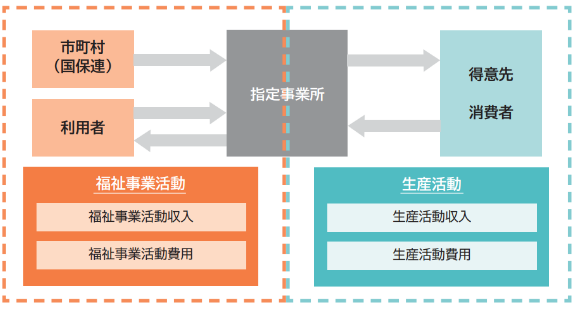
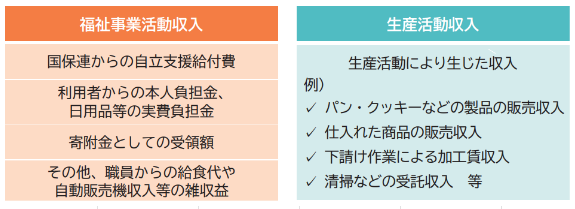
Classification of income related to welfare business activities and production activities
Income from welfare activities comes mainly from subsidies and user fees, while the main source of income for production activities is sales of products.
Income generated from welfare business activities and income generated from productive activities are classified as follows:
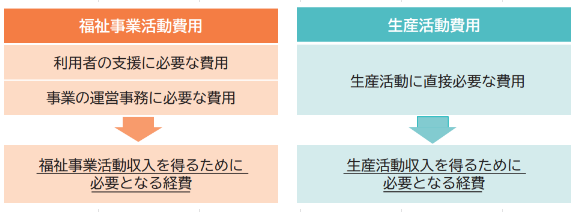
Classification of costs related to welfare business activities and production activities
Classification of costs is also important, and it is necessary to clearly separate costs related to welfare business activities (e.g., labor costs of nursing staff required for daily care) from costs related to production activities (e.g., material costs and equipment costs).
Expenses in employment support projects are divided into costs arising from welfare business activities and costs arising from production activities as follows.
Please consult with the support administrative scrivener corporation
There are many consultants with specialized know-how in support of continued employment, but administrative scriveners, who represent companies on a daily basis and handle applications and negotiations with administrative agencies, have the know-how and track record that can be accumulated.
We fully support our clients' business operations by making full use of our know-how and track record.
We also have offices in four locations across the country, in Tokyo, Nagoya, and Osaka, and can provide nationwide service from these bases.
Please leave the specialized and complicated procedures to us.
The first consultation is free.