[Latest Version] A Thorough Explanation of Subsidies for New Business Entry and Manufacturing/Commercial Services
[2026 Latest News] New business transfer, new business, sales, sales, money, etc.
~ Up to 9,000 million yen in large-scale support! Encouraging challenges in new markets and high value-added businesses ~
[Latest Version] A Thorough Explanation of Subsidies for New Business Entry and Manufacturing/Commercial Services
Overview and purpose of the system
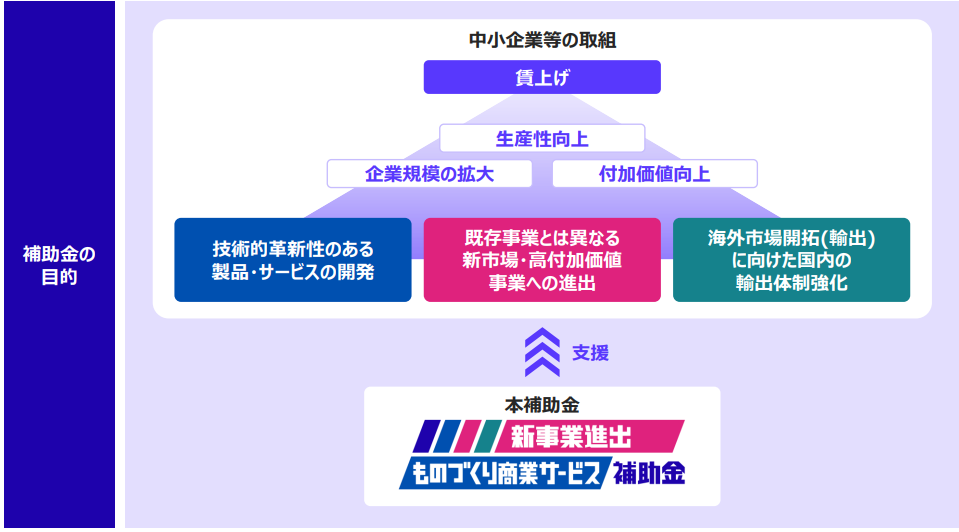
The "Subsidy for New Business Entry for Small and Medium-Sized Enterprises" and the "Manufacturing Subsidy" have been merged to form a new system. This subsidy aims to support proactive challenges in new markets and high value-added businesses. It is expected that by expanding the scale of operations and increasing added value for small and medium-sized enterprises, productivity will improve, leading to the development of regional economies and the realization of sustainable wage increases.
First application period: September 30, 2026 (Wed) - October 30, 2026 (Fri) 18:00
[Latest Version] A Thorough Explanation of Subsidies for New Business Entry and Manufacturing/Commercial Services
Three categories of projects eligible for subsidies and cases that are "not eligible".
Based on your company's business plan, you will apply from one of the following three business categories. Careful verification is necessary to ensure that you meet the requirements, and in particular, that you do not fall under any of the "ineligible (not applicable)" categories.
Category ①: Innovative New Products and Services Category
This program targets businesses that develop new products and services by leveraging their technological capabilities, etc., with the aim of providing new value to customers and others.
[Note] Examples of cases that "do not qualify" for technological innovation.
Only improvements to the production process:This is the case when simply introducing new processing machines to an existing product production line to increase efficiency.
Installation of machinery and equipment only:This applies to cases where the scope of work is expanded simply by acquiring new machinery, without developing new products.
Development of already widely used products:When introducing a system that has already been widely adopted by other companies in the same industry (e.g., mobile ordering in restaurants).
Slot ②: Slot for new business entry
For your company, the products you manufacture must be "novel" and the target market must be a "new market" different from your previous ones. (※It does not need to be the first in Japan or the world.)
[Note] Examples of cases where the novelty of the product, etc., and the market is "not applicable".
Increased production volume/remanufacturing:This can simply involve increasing the production volume of existing products or re-manufacturing parts that were previously produced.
Only changes to the manufacturing method:This refers to cases where the manufacturing method is simply changed from manual labor to machine (digitalization).
Equivalent performance, already sold:This applies if there is no difference in performance compared to conventional products, or if sales and revenue have already been generated at the time the public offering begins.
Only within the same market or a portion of the market:This could include cases where the target customers are the same, such as selling shaved ice instead of ice cream, or specializing in only vanilla flavor.
The only difference is the market area:If the product offered in front of Station A is simply offered in front of Station B.
Slot ③: Global Slot
The requirements are that companies must work to strengthen their domestic manufacturing and other bases in order to proactively develop new overseas sales channels using their own products, and that the target overseas market must be a new market for the company.
[Note] Examples of cases where the novelty of overseas sales channels and markets is "not applicable"
Resale of competitors' products and inbound sales:This includes cases where purchased products are exported as is, or where a sales system is established "domestically" for foreign visitors to Japan.
Involuntary development (initiated by other companies):This includes cases where manufacturing lines are built based on orders from business partners, or where sales strategies are simply followed by trading companies or parent companies.
Without strengthening domestic bases:This scenario involves not strengthening the domestic system, but instead establishing or expanding overseas bases for local production and sales.
Extension of existing markets:This applies to cases where the only changes are to the state or province of the existing export destination (country or region), or to simply increasing production, expanding sales, or switching supply routes.
[Latest Version] A Thorough Explanation of Subsidies for New Business Entry and Manufacturing/Commercial Services
Regarding subsidy amounts, subsidy rates, and the application of "special provisions"
The amount and rate of the subsidy vary depending on the project category applied for, the number of employees, and whether or not the "wage increase special provision" or the "regional minimum wage increase special provision" is applicable.
First application deadline: Friday, October 30, 2026, 18:00 [Strictly enforced]
① Innovative new product/service category
Employees
Subsidy amount (minimum to maximum)
Maximum amount when special provisions are applied (*1)
1~5 人
100 million yen to 750 million yen
850 million yen
6~20 人
100 million yen to 1,000 million yen
1,250 million yen
21~50 人
100 million yen to 1,500 million yen
2,500 million yen
51 people more
100 million yen to 2,500 million yen
3,500 million yen
Subsidy rate: Small and medium-sized enterprises are subject to a 1/2 minimum wage (2/3 if the special provision for regional minimum wage increases applies).
Small businesses, small enterprises, and business restructuring companies account for 2/3
*【Notes on applying for special provisions】Small and medium-sized enterprises applying under the innovation framework cannot apply for both the "wage increase special provision" and the "regional minimum wage increase special provision." Also, businesses undergoing restructuring cannot apply for the "wage increase special provision."
② New Business Entry Category / ③ Global Category (Amount is the same for all categories)
Employees
Subsidy amount (minimum to maximum)
Maximum amount when special provisions are applied (*1)
1~20 人
750 million yen to 2,500 million yen
3,000 million yen
21~50 人
750 million yen to 4,000 million yen
5,000 million yen
51~100 人
750 million yen to 5,500 million yen
7,000 million yen
101 people more
750 million yen to 7,000 million yen
9,000 million yen
Subsidy rate (for new business entry): Small and medium-sized enterprises are subject to a 1/2 minimum wage (2/3 if the regional minimum wage increase special provision applies).
Subsidy rate (global quota): Flat rate 2/3
*【Notes on the application of special provisions】Businesses applying under the New Business Entry category can use both special provisions. On the other hand, businesses applying under the Global category cannot apply the "Regional Minimum Wage Increase Special Provision". Also, if the amount of the subsidy application does not reach the normal upper limit, the wage increase special provision will not be applied.
Notes on the project implementation period and "early commencement"
The implementation period (deadline) for capital investment, etc., varies depending on the project framework. All procedures, including contracting, delivery, inspection, and payment, must be completed within the specified period.
Category 1: Innovation Category: Within 10 months from the date of grant approval (maximum of 12 months from the date of selection announcement)
Slot ② New Business Slot / Slot ③ Global Slot: Within 14 months from the date of grant approval (maximum of 16 months from the date of selection announcement)
[Strictly enforced] Pre-start work is prohibited.
Expenses contracted (ordered) before the grant decision date will not be eligible for subsidies for any reason. Also, delays in submitting the grant application will shorten the actual project implementation period, so it is necessary to complete the grant application procedure as soon as possible after being selected.
[Latest Version] A Thorough Explanation of Subsidies for New Business Entry and Manufacturing/Commercial Services
Specific examples of the "new business ventures" that will be targeted.
This program targets bold business transformations that meet the "novelty requirements for products, etc." and the "novelty requirements for markets" outlined in the New Business Entry Guidelines.
★ Retail
Clothing retailer:The company shifted its business model from retail clothing stores to online sales and subscription-based service businesses.
Gasoline sales:Started operating a new fitness gym. Responding to local health promotion needs.
★ Manufacturing industry
Aircraft parts manufacturing:Leveraging our accumulated expertise, we launched new businesses manufacturing robot-related parts and medical device components.
Traditional craft manufacturing:Due to a drastic drop in sales at department stores and other retailers, they started selling their products online through e-commerce sites.
★ Construction/Transportation industry
Civil engineering and landscaping:We are making a new entry into the tourism business by developing an auto campground using our own land.
Taxi business:Obtained a new license for general freight vehicle transportation business and began home delivery services for food and other items.
★ Food and beverage industry / Service industry
Coffee shop owner:The restaurant space has been reduced and coffee beans and baked goods are now available for takeout.
Yoga classes:In order to avoid crowding indoors, we have started running yoga classes in an online format.
[Latest Version] A Thorough Explanation of Subsidies for New Business Entry and Manufacturing/Commercial Services
12 categories of eligible expenses and important rules
This subsidy categorizes necessary project expenses into 12 categories. It's important to note that the "expenses that can be claimed" and "expenses that must be claimed" differ depending on the project category.
[Important] Essential requirements and general principles for application
Essential expenses: Category 1 (Innovation Category) requires "Machinery and System Construction Costs". Category 2 (New Business Category) and Category 3 (Global Category) require either "Machinery and System Construction Costs" or "Building Costs".
One-time expenses are a no-no: Business plans in which one-time expenses constitute the majority of eligible expenses will not be eligible for support.
Restrictions on the disposal of property: If you dispose of or sell the acquired property (machinery, buildings, etc.), you may be required to repay (return) the subsidy.
Details and limits (restrictions on the amount that can be claimed) for each expense category.
Expense classification
Eligible business framework
Contents and limits/special notes
Machinery and system construction costs
Frames ①, ②, and ③
Purchase, manufacture, or lease of specialized machinery and equipment, and costs for developing specialized software and systems.
Building costs
Frames ② and ③ only
Construction and renovation costs for production and processing facilities, etc. (*Category 1 is excluded)
Outsourcing cost
Frames ①, ②, and ③
Outsourcing costs for inspection, processing, design, security assessments, etc. [Maximum] Up to 1/4 of the total eligible expenses (excluding tax).
Technology introduction costs / Intellectual property rights and related expenses
Frames ①, ②, and ③
This includes costs for introducing intellectual property rights, and fees for patent attorney procedures for obtaining patents. [Maximum] Up to 1/3 of the total eligible expenses (excluding tax) for each item.
Professional Expenses
Frames ①, ②, and ③
Remuneration for experts necessary for carrying out the project (university professors, lawyers, etc.). [Maximum] Up to 1/5 of the total eligible expenses (excluding tax).
Advertising and sales promotion expenses
Frames ①, ②, and ③
Creating advertisements for new products, media placement, PR website construction, and exhibition participation fees. [Maximum] Up to 5% of projected new sales (excluding tax) (per year of the business plan period)
Cloud service usage fee
Frames ①, ②, and ③
Server space rental and cloud service usage fees.
Raw material costs / Transportation costs
Frames ①, ②, and ③
Raw materials and auxiliary materials necessary for prototype development. Transportation and delivery fees, etc.
Overseas travel expenses
Frame ③ only
Travel and accommodation expenses for purposes such as expanding overseas business (with restrictions such as a maximum of 3 people per trip). [Maximum] 1/5 of the total eligible expenses (excluding tax), up to a maximum of 500,000 yen per person.
Interpretation and translation fees
Frame ③ only
Only translation costs necessary for advertising, promotion, and sales are covered (translations of contracts, etc., are not included). [Maximum] Up to 30 yen
[Important Note] Typical expenses that are not eligible for subsidies.
The following expenses, even if included in your budget, will be deemed "ineligible" during the review process.Please note that if the majority of the expenses listed are not eligible for subsidies, your application may be rejected or its approval may be revoked.
Items that are versatile and could be used for purposes other than their intended use: Personal computers, tablets, smartphones, printers, general word processing software, furniture, home appliances, etc.
Diversion to existing businesses, gift certificates, etc.: Expenses that are not deemed to be "used exclusively for the subsidized project," such as those used in existing businesses, as well as gift certificates and various insurance premiums.
Power generation facilities, etc.: Power generation equipment for generating renewable energy and ancillary equipment (such as solar panels) that is an integral part of said equipment.
Payments to related parties: Payments to businesses that include the same representative or officers as the applicant, deemed to be the same business, or businesses with a capital relationship, as well as payments between departments within the same business.
Other exclusions: This includes fees for handling procedures that the applicant should perform themselves, expenses already covered by other government programs that specify the purpose of the expense, and items that are far removed from market prices.
[Latest Version] A Thorough Explanation of Subsidies for New Business Entry and Manufacturing/Commercial Services
Cases where subsidies are available and cases where they are not.
This subsidy is available to small and medium-sized enterprises (SMEs) and other entities with their head office and project implementation location located in Japan. Before applying, please be sure to check whether your company meets the requirements and does not fall under any of the "ineligible" conditions.
Main corporations and individuals eligible for subsidies
Companies or individuals that meet either the "capital" or "number of full-time employees" criteria set for each industry are eligible.
Main industries
Capital
Number of full-time employees
Manufacturing industry, construction industry, transportation industry
3 million yen or less
300 or fewer
Wholesale trade
1 million yen or less
100 or fewer
Service industry (Excluding software, information processing services, and lodging businesses)
Below 5,000 yen
100 or fewer
Retail trade
Below 5,000 yen
50 or fewer
Small businesses and small enterprises: Businesses with 20 or fewer employees in manufacturing, etc., and 5 or fewer employees in commercial and service industries (excluding accommodation and entertainment) are eligible for preferential subsidy rates (2/3) in certain categories.
Other target corporations: This includes cooperatives such as business cooperatives, joint ventures, and business cooperatives, as well as some specific businesses that meet certain requirements, specified non-profit organizations, and agricultural cooperative corporations.
[Important] Main conditions for businesses that are ineligible for subsidies
Even if a small or medium-sized enterprise meets the requirements, if any of the following apply:Application not accepted (not eligible).
■ Restrictions on past subsidy receipts
Starting from the application deadlineWithin the last 16 monthsBusinesses that have been selected for one of the following subsidies: "New Business Entry/Manufacturing Subsidy," "New Business Entry Subsidy," "Business Restructuring Subsidy," or "Manufacturing Subsidy."
As of the application deadline, the applicant has received the grant decision for the above subsidy.Subsidized project currently underwayA business operator.
Starting from the application datePast 3 yearsThe decision to grant the above subsidy has been made.More than 2 times in totalThe business that received the order.
■ Company size and other restrictions
Large corporations (as defined by their classification): A business entity that is under the control of a large corporation, such as when a single large corporation owns more than half of the total number of outstanding shares or the total value of investments.
At the time of applicationNumber of employees: 0A business operator.
Newly established or founded less than one year agoBusiness operators (※Limited to those entering a new business).
Businesses that have previously had their subsidy applications revoked or grant decisions revoked, or businesses that have not complied with payment or repayment orders.
Political organizations, religious corporations, unincorporated associations, and corporations that do not engage in profit-making activities.
[Latest Version] A Thorough Explanation of Subsidies for New Business Entry and Manufacturing/Commercial Services
Essential requirements for eligible projects (application requirements)
In order to receive the subsidy, you must formulate and implement a business plan that meets all of the following six basic requirements.If the requirements are not met, you may be required to repay all or part of the subsidy, so it is important to set achievable goals.
1. Value-added requirement
During the project plan period of 3 to 5 years after the completion of the subsidized project,The average annual growth rate of value added is "+4.0% or higher".To formulate and achieve goals that will result in [this outcome].
*If you set a target higher than +4.0% (e.g., 4.2%), even if your actual performance is 4.0% or higher, it will be considered "failed" if it falls below your self-set target (4.2%). Please set a realistic and achievable number that is not excessively high.
2. Wage increase requirements & 3. Minimum wage level requirements within the workplace
Wage increase requirements: During the project plan period of 3 to 5 years after the completion of the subsidized project,The average annual growth rate of total wages paid per person is "+3.5% or more".To formulate and achieve goals that will result in [this outcome].
Minimum wage level requirements within the workplace: During the business plan period of 3 to 5 years after the completion of the subsidized project, the minimum wage within the workplace will be increased annually.Regional minimum wages are "at a level of 30 yen or more higher."To be.
[WARNING] Refund policy for non-delivery - If wage increase requirements are not met: You will be required to repay an amount equal to the subsidy amount multiplied by the "percentage of failure to achieve the target value" (※In the case of negative growth, the entire amount must be repaid). - If the minimum wage level requirement is not met: You will be required to repay an amount equal to the subsidy amount divided by the number of years in the project plan period.
Other basic requirements 4-6
4. Work-life balance requirements: By the time of application, applicants must have formulated a "General Employer Action Plan" based on the Act on Promotion of Measures to Support the Development of the Next Generation and published it on the "Work-Life Balance Support Plaza."
5. Requirements for initiatives to improve the workplace environment regarding childcare, etc.: Choose and implement one of the following: "Utilization of life design services," "Utilization of various services aimed at supporting childcare, etc.," or "Dissemination and promotion of various existing systems to employees" (※Exemption applies if you have obtained Kurumin certification, etc.).
6. Financial Institution Requirements: If receiving funding from a financial institution, the business plan must be confirmed (a confirmation document must be submitted) by the funding institution (an institution with a financial institution code recognized by the Financial Services Agency).
[Significant Increase in Limits] Regarding the Requirements for Special Measures
To receive an increase in the maximum subsidy amount or subsidy rate (special provision), you must meet the following even stricter requirements.
① Special requirements for wage increases (raising the maximum subsidy amount)
The following twoBothTo formulate goals to be achieved.
Average annual growth rate of total wages paid per person +6.0% or more(An additional 2.5% on top of the basic requirement's +3.5%)
The minimum wage within the workplace is lower than the regional minimum wage. Annual fee + 50 yen or moreHigh level (an additional 20 yen on top of the basic requirement of +30 yen)
*If either of the targets is not met, the full amount of the increased subsidy will be required to be repaid.
② Special requirements for raising regional minimum wages (increase in subsidy rate)
Between October 2024 and September 2025, employees who are employed at a rate "above the regional minimum wage for that period and below the regional minimum wage revised for fiscal year 2025" are subject to the following conditions:For three or more months, the percentage of employees exceeding 30% of the total workforce has been observed.There is.
[Latest Version] A Thorough Explanation of Subsidies for New Business Entry and Manufacturing/Commercial Services
Leave the complicated application process to the experts!
To ensure that a new business concept is successfully translated into a viable business plan that will be approved, specialized expertise is essential.
Extensive experience: We have a track record of handling over 3,000 applications for subsidies in general. We analyze the trends in successful applications daily and provide support accordingly.
National accreditation body: As a "certified support organization" of the Ministry of Economy, Trade and Industry, we will utilize our specialized knowledge and practical experience in supporting small and medium-sized enterprises.
A secure compensation system: We generally operate on a success-based fee system with no upfront fees. If your application is not accepted, we will not charge you any fees.(※Subject to change depending on circumstances)
Nationwide service: Our expert team provides support to businesses nationwide through the use of web-based interviews and other tools.
*The deadline for the first round of applications (October 30, 2026) is fast approaching. Please contact us as soon as possible.